

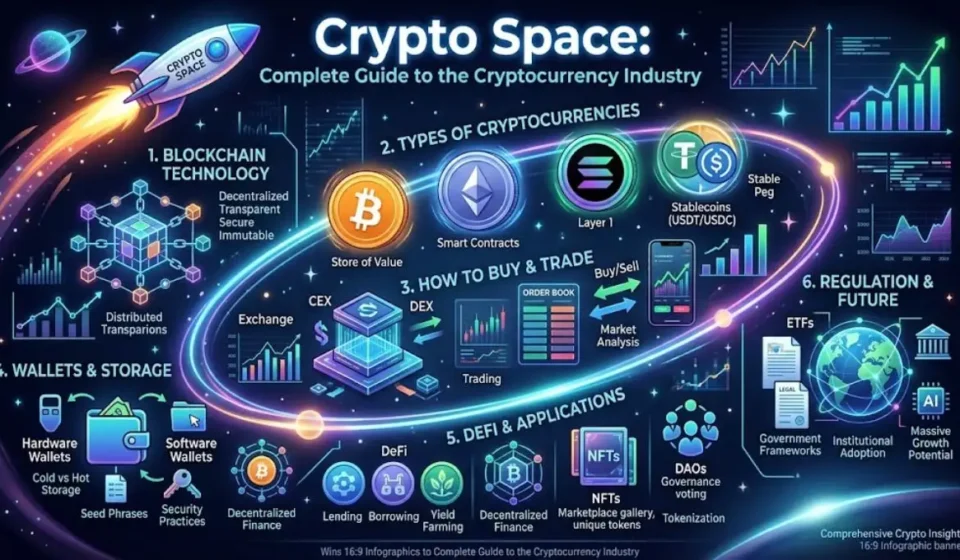

The crypto space has grown from a small experiment in digital money into a broad industry covering cryptocurrencies, blockchain networks, decentralized finance, stablecoins, NFTs, tokenization, and Web3.
As of September 29, 2026, the global crypto market is worth about $2.86 trillion, while Bitcoin represents about 58.6% of the total market by market dominance, according to CoinMarketCap’s live market dashboard.
This guide explains how the crypto space works, its major sectors, important trends in 2026, and the risks users should understand.
What Is the Crypto Space?
The crypto space is the wider ecosystem built around cryptocurrencies and blockchain technology. It includes digital assets, exchanges, wallets, decentralized applications, blockchain networks, and related financial services.
Bitcoin was the starting point for modern cryptocurrency. Today, the industry includes thousands of digital assets with different purposes, designs, and levels of adoption.
Some crypto assets are designed mainly as digital money, while others support smart contracts, applications, payments, governance, or tokenized assets.
Main parts of the crypto space
- Cryptocurrencies such as Bitcoin and Ether
- Stablecoins linked to traditional currencies
- Blockchain networks
- Decentralized finance, or DeFi
- NFTs and digital collectibles
- Web3 applications
- Crypto exchanges and wallets
- Tokenized real-world assets
- Blockchain infrastructure and development tools
How Does the Crypto Space Work?
Blockchain networks use distributed databases to record transactions. Instead of relying on one central database, many networks distribute transaction records across participating computers.
Ethereum describes a blockchain as a public database shared across many computers. Its network uses proof of stake, where validators help confirm transactions and maintain the network.
Different blockchains use different designs. Bitcoin uses proof of work, while Ethereum moved to proof of stake in 2022.
The basic process usually looks like this:
- A user creates a transaction.
- The transaction is broadcast to the network.
- Network participants verify it.
- Valid transactions are included in a block.
- The blockchain records the new block.
- The transaction becomes part of the network’s history.
Smart-contract networks add another layer by allowing software to run directly on the blockchain.
Why Is the Crypto Space Growing?
The crypto space has expanded because blockchain technology can support more than simple digital payments.
Stablecoins, decentralized applications, tokenized assets, and blockchain-based financial services have created new use cases.
Current data also shows the scale of these markets. DefiLlama reported roughly $307 billion in total stablecoin market capitalization and about $95 billion in DeFi total value locked in late September 2026.
Several factors are supporting continued development:
- Greater interest in digital payments
- Growth of stablecoins
- Expansion of DeFi
- Institutional participation
- Tokenization of traditional assets
- Better blockchain infrastructure
- More regulatory frameworks
- Growing interest in Web3 applications
Growth does not mean every cryptocurrency will succeed. The industry remains highly competitive and volatile.
Major Sectors Within the Crypto Space
The crypto space is made up of several connected sectors.
| Sector | Main Purpose |
| Bitcoin | Digital monetary network |
| Smart-contract platforms | Run decentralized applications |
| Stablecoins | Digital assets designed to maintain stable value |
| DeFi | Financial services using blockchain-based protocols |
| NFTs | Represent unique digital or physical-linked assets |
| Web3 | Decentralized applications and services |
| Tokenization | Represent assets on blockchain networks |
| Exchanges | Facilitate crypto trading |
| Wallets | Store and manage digital assets |
| Blockchain infrastructure | Supports networks, applications, and transactions |
These sectors often overlap. For example, stablecoins can be used inside DeFi applications, while tokenized assets can trade through blockchain-based infrastructure.
How Blockchain Technology Powers the Crypto Space
Blockchain is the underlying technology behind many parts of the crypto space.
A blockchain records transactions in blocks that are connected to previous blocks. Cryptographic techniques help protect the history of those records.
Ethereum’s documentation explains that changing blockchain history would require changing subsequent blocks and reaching network consensus.
Blockchain technology can provide:
- Shared transaction records
- Programmable transactions
- Digital ownership
- Transparent verification
- Automated smart contracts
- Peer-to-peer transfers
However, blockchain systems can also face challenges such as scalability, network fees, smart-contract bugs, governance disputes, and security risks.
Popular Cryptocurrencies in the Crypto Space
Bitcoin remains the largest cryptocurrency by market dominance. CoinMarketCap’s September 29, 2026 dashboard showed Bitcoin at about 58.6% dominance, followed by Ethereum at about 11.4%.
| Cryptocurrency | Symbol | General Role |
| Bitcoin | BTC | Digital monetary network |
| Ethereum | ETH | Smart contracts and decentralized applications |
| BNB | BNB | Blockchain ecosystem and applications |
| Solana | SOL | High-throughput blockchain applications |
| XRP | XRP | Payments and settlement-focused ecosystem |
| Tether | USDT | Dollar-pegged stablecoin |
| USD Coin | USDC | Dollar-pegged stablecoin |
Market positions and prices can change quickly, so cryptocurrency rankings should always be checked using current market data.
Bitcoin has a maximum supply of 21 million coins. Its block reward is reduced through scheduled halvings, with the most recent halving occurring in April 2024.
Crypto Space Trends to Watch in 2026
The crypto space in 2026 is increasingly focused on practical infrastructure rather than only token launches.
1. Stablecoins
Stablecoins have become one of the largest parts of the digital-asset ecosystem. DefiLlama’s current data puts total stablecoin market capitalization above $307 billion.
They are used for trading, transfers, DeFi applications, and other blockchain transactions.
2. Real-World Asset Tokenization
Tokenization involves representing assets or financial instruments through blockchain-based tokens.
The idea is being explored for areas such as securities, funds, payments, and other financial infrastructure.
3. On-Chain Financial Markets
Blockchain networks are increasingly being used to build trading and financial infrastructure.
In September 2026, the SEC introduced a temporary conditional exemption related to certain tokenized stock trading venues, allowing limited on-chain trading under specified conditions.
4. DeFi Development
DeFi continues to develop across lending, trading, liquidity, derivatives, and other financial applications.
DefiLlama currently tracks thousands of protocols and reports around $95 billion in DeFi TVL.
5. Regulatory Clarity
Regulation is becoming an important part of the crypto industry.
In March 2026, the SEC issued an interpretation addressing how federal securities laws apply to certain crypto assets and transactions.
In August 2026, the SEC also proposed its Regulation Crypto Assets framework for certain investment contracts involving crypto assets.
DeFi and Its Role in the Crypto Space
Decentralized finance, commonly called DeFi, uses blockchain-based protocols to provide financial functions without relying on traditional financial intermediaries for every transaction.
Common DeFi categories include:
- Decentralized exchanges
- Lending and borrowing
- Liquidity pools
- Stablecoin applications
- Derivatives
- Staking-related services
Smart contracts automatically execute programmed rules when their conditions are met.
DeFi can improve access and programmability, but it also introduces risks. A smart-contract bug, oracle failure, liquidity problem, or exploit can result in significant losses.
NFTs, Web3, and the Expanding Crypto Space
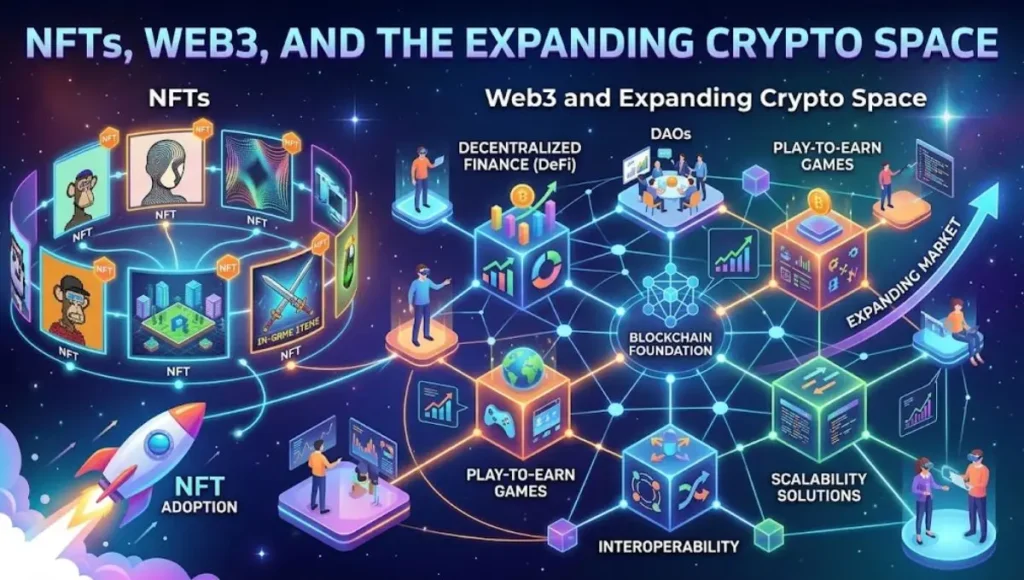
NFTs are blockchain-based tokens designed to represent unique items or rights. They have been used for digital collectibles, gaming assets, memberships, artwork, and other applications.
Web3 is a broader concept focused on applications where users can interact with blockchain networks and digitally controlled assets.
The modern Web3 ecosystem can include:
- Decentralized applications
- Blockchain games
- Digital identity systems
- NFTs
- DAOs
- Token-based communities
- Decentralized storage
Not every Web3 project has the same level of adoption, and users should examine the technology and project fundamentals rather than relying only on online popularity.
How to Get Started in the Crypto Space
Learning should come before making financial decisions.
Start by understanding basic terms such as blockchain, wallet, private key, public address, token, stablecoin, smart contract, and transaction fee.
A simple learning path is:
- Learn how blockchain works.
- Understand the difference between coins and tokens.
- Learn how crypto wallets work.
- Study transaction fees and network confirmations.
- Understand common scams and security threats.
- Research regulations that apply in your country.
- Never share private keys or recovery phrases.
Because cryptocurrency can be highly volatile and losses can be permanent, beginners should focus on education and security rather than trying to make quick profits.
How to Choose a Crypto Exchange and Wallet
A crypto exchange is a platform that can facilitate the buying, selling, or trading of digital assets.
A wallet is generally used to control and manage blockchain assets and transactions. Different wallets have different security models.
When evaluating crypto services, consider:
- Security history
- Regulatory status
- Supported assets
- Fees
- Withdrawal rules
- Account protection
- Transparency
- Customer support
- Availability in your country
Never choose a service only because someone promises fast or guaranteed returns.
Private keys and recovery phrases should also be treated as extremely sensitive information.
Risks and Challenges in the Crypto Space
The crypto space offers new technology but also carries substantial risks.
Major risks include
- High price volatility
- Scams and fraud
- Hacked accounts
- Lost private keys
- Smart-contract vulnerabilities
- Fake tokens and websites
- Liquidity problems
- Regulatory changes
- Network congestion
- Market manipulation
The FATF reported in March 2026 that stablecoins had expanded rapidly and highlighted illicit-finance risks involving stablecoins and peer-to-peer transactions through unhosted wallets.
Another important risk is assuming that blockchain technology automatically makes a project safe. A decentralized system can still contain flawed code, weak governance, or insecure applications.
Crypto Space Regulation and Security
Crypto regulation varies significantly between countries.
In the United States, the regulatory framework continued developing during 2026. The SEC’s March interpretation addressed categories including digital commodities, digital collectibles, digital tools, stablecoins, and digital securities.
The SEC’s August 2026 proposal for Regulation Crypto Assets included proposed exemptions for certain covered investment contracts, including a proposed startup exemption of up to $5 million over four years and another proposed exemption of up to $75 million during a 12-month period. These were proposals rather than universal rules for all cryptocurrencies.
Security is equally important.
Users should:
- Use strong account security.
- Enable multi-factor authentication where available.
- Verify website addresses before connecting wallets.
- Never share recovery phrases.
- Be careful with unknown tokens and links.
- Review transactions before confirming them.
- Keep important assets secured appropriately.
Future of the Crypto Space
The future of the crypto space is likely to involve a combination of blockchain infrastructure, stablecoins, tokenization, DeFi, and traditional financial systems.
One major development is the movement of traditional financial assets onto blockchain-based systems.
The SEC’s September 2026 Innovation Exemption shows that tokenized securities are becoming part of active regulatory and market discussions in the United States.
The Bank for International Settlements also highlighted tokenization and stablecoins in June 2026, while noting that stablecoins have structural limitations and can create financial-stability concerns if adoption becomes widespread.
The industry will likely continue changing as technology, regulation, user demand, and traditional finance interact.
Frequently Asked Questions
What is the crypto space?
The crypto space is the wider ecosystem of cryptocurrencies, blockchain networks, exchanges, wallets, DeFi, NFTs, Web3, and related technologies.
How big is the crypto space in 2026?
As of September 29, 2026, CoinMarketCap’s live dashboard showed total crypto market capitalization at about $2.86 trillion.
What is the biggest cryptocurrency?
Bitcoin is currently the largest cryptocurrency by market capitalization and accounted for about 58.6% of total crypto market dominance in the cited September 2026 snapshot.
What is DeFi in the crypto space?
DeFi means decentralized finance and refers to blockchain-based applications that provide functions such as trading, lending, borrowing, and liquidity services.
Are stablecoins part of the crypto space?
Yes. Stablecoins are an important part of the crypto space, with total stablecoin market capitalization above $307 billion in late September 2026.
What is blockchain technology?
Blockchain is a shared digital database that records information across a network, with cryptographic links and consensus mechanisms helping maintain the record.
Is the crypto space safe?
The technology can be useful, but crypto services and assets carry risks including volatility, scams, hacks, software vulnerabilities, and regulatory uncertainty.
What is the future of the crypto space?
Key areas to watch include stablecoins, tokenization, DeFi, blockchain infrastructure, Web3 applications, and the development of clearer regulatory frameworks.
Conclusion
The crypto space is now much broader than Bitcoin or cryptocurrency trading. It includes blockchain networks, stablecoins, DeFi, NFTs, Web3, tokenization, and increasingly connected financial infrastructure.
Current 2026 data shows a large and active ecosystem, with total crypto market capitalization around $2.86 trillion, stablecoins above $307 billion, and DeFi TVL around $95 billion in late September.
At the same time, the industry still faces major challenges involving security, volatility, regulation, and responsible use.
Understanding how the technology works and checking current information is essential for anyone researching the rapidly changing crypto space.