

ASX trading means buying and selling securities listed on the Australian Securities Exchange. The ASX is Australia’s main share market and provides access to more than 2,200 securities across companies, exchange-traded products and other listed investments.
This guide explains how ASX trading works, market hours, share prices, trading methods, costs, risks, and important ASX indexes. The information below is updated for September 2026 where current market data is available.
What Is ASX Trading?
ASX trading is the process of buying and selling shares and other listed securities through the Australian Securities Exchange. A trade is normally placed through a broker that connects an investor to the market.
The ASX includes companies from sectors such as banking, mining, healthcare, technology, energy, property and consumer goods.
For beginners, it is important to understand that share prices can rise or fall quickly. A trading decision should therefore be based on research, risk awareness and a clear plan.
How Does ASX Trading Work?
ASX trading works through an electronic market where buyers and sellers submit orders. The exchange matches eligible buy and sell orders according to price and time priority during normal trading.
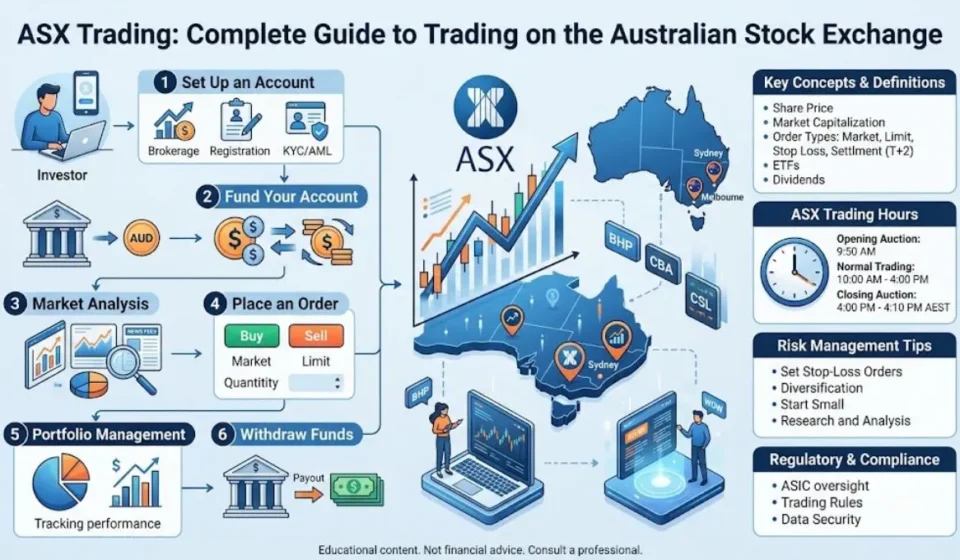
A typical process looks like this:
- Open an account with a broker.
- Add money to the account.
- Search for an ASX-listed security.
- Choose an order type.
- Enter the number of shares.
- Review the estimated cost and fees.
- Submit the order.
- Monitor the trade and confirmation.
Common order types include market orders and limit orders. A market order seeks the next available price, while a limit order sets the maximum buying price or minimum selling price.
How to Start ASX Trading
Before placing a trade, learn how the ASX market works and understand the security you are considering.
A basic preparation checklist includes:
- Learn the difference between shares and indexes.
- Understand market and limit orders.
- Check company announcements and financial information.
- Compare trading costs.
- Decide how much risk you can accept.
- Keep records of your trades.
- Avoid making decisions based only on short-term price movements.
The Australian government’s Moneysmart service notes that investors can use online or full-service brokers to buy and sell shares on the ASX.
Best ASX Trading Strategies
There is no single strategy that works in every market. Different traders may use price trends, company research, volume or technical indicators to make decisions.
Common approaches include:
| Strategy | Basic idea |
| Trend trading | Looks for sustained upward or downward price movement |
| Momentum trading | Focuses on securities showing strong recent movement |
| Breakout trading | Watches for price movement beyond an important level |
| Swing trading | Holds a position for days or weeks |
| Fundamental analysis | Studies company results, valuation and business conditions |
New traders should understand a strategy before using it with real money. Past performance does not guarantee future results.
ASX Trading Hours and Market Sessions
ASX cash-market sessions use Sydney time. The current equity-market structure has a pre-open period followed by an opening auction and normal trading.
| Market phase | Sydney time |
| Pre-open | 7:00 am–9:59 am |
| Opening auction | Around 9:59 am |
| Normal trading | Around 9:59:45 am–4:00 pm |
| Pre-closing auction | 4:00 pm–4:10 pm |
| Closing auction | Around 4:10 pm–4:11 pm |
| Post-close | 4:11 pm–4:21:30 pm |
The opening and closing auction times include randomized elements, so traders should check the official ASX trading-hours page for the exact session rules.
The ASX is also closed on Australian market holidays. The 2026 calendar includes closures such as New Year’s Day, Australia Day, Good Friday, Easter Monday, King’s Birthday and Christmas Day.
Popular ASX Stocks for Trading
The ASX has companies across many industries. Large and widely followed companies include businesses in banking, mining, healthcare, technology and energy.
Examples often followed by market participants include:
- BHP
- Commonwealth Bank
- CSL
- Rio Tinto
- Westpac
- ANZ
- NAB
- Fortescue
These names are examples of well-known ASX-listed companies, not recommendations to buy or sell them.
The ASX also provides market statistics showing daily trading volumes, trading value and the most actively traded shares.
ASX Trading Fees and Costs
Trading costs can reduce returns, particularly when making many small trades.
Common costs include:
- Brokerage charged by the broker
- Platform or account fees
- Currency-conversion costs for overseas securities
- Taxes that may apply to investment income or capital gains
Moneysmart says online brokers often charge a flat fee for smaller trades, while some may use percentage-based pricing for larger transactions. Fees vary between providers, so investors should check the current fee schedule before trading.
ASX Share Prices Today
ASX share prices change throughout the trading session, so a live price should always be checked close to the time of the trade.
On 29 September 2026, the ASX market was preparing for the session. At about 7:05 am AEST, ABC reported ASX 200 futures at 8,727 points, up 0.1%, while the previous ASX 200 close was 8,679.7 on 28 September.
The previous session’s All Ordinaries close was 8,850.70, up 0.06% on 28 September 2026.
Because share prices move during market hours, these figures should not be treated as a permanent “today” price. For live prices, check the ASX market-data pages or a current market-data service.
ASX Trading Platforms and Brokers
Investors generally access ASX securities through a broker. An online broker allows users to place their own orders, while a full-service broker may provide additional services or advice.
When comparing a broker, consider:
- Brokerage per trade
- Account fees
- Available order types
- Market-data access
- Security features
- Customer support
- Reporting and tax documents
Moneysmart explains that most people buying shares use an online broker and that ASX provides a broker-finding service.
ASX Trading vs Investing: What Is the Difference?
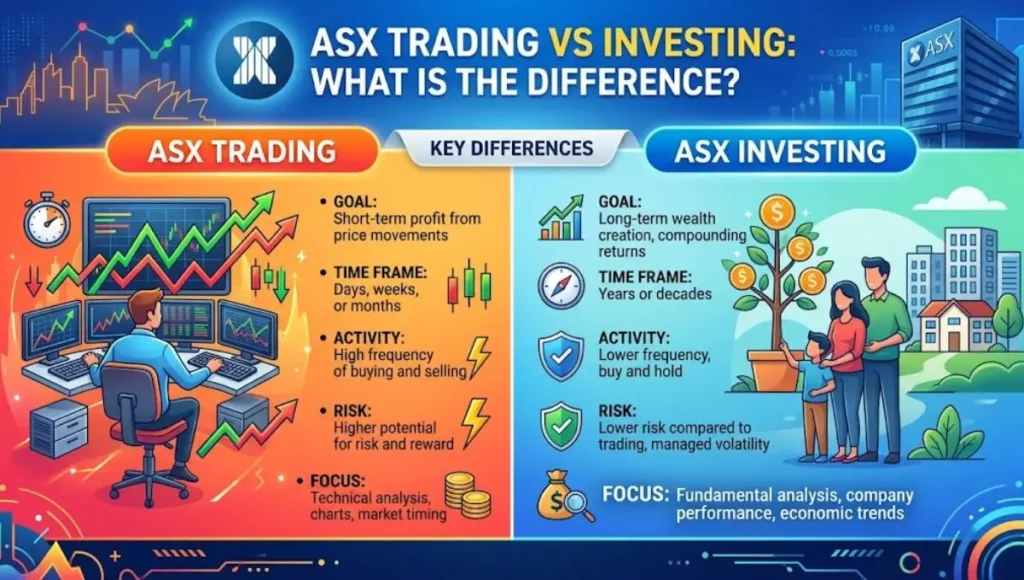
ASX trading and investing both involve buying and selling securities, but the time horizon and approach can differ.
| ASX Trading | ASX Investing |
| Often focuses on shorter periods | Usually focuses on longer periods |
| May use price and market signals | Often focuses on business fundamentals |
| Can involve more frequent transactions | May involve fewer transactions |
| Short-term price changes matter more | Long-term growth and income may matter more |
Neither approach removes market risk. The right approach depends on a person’s goals, time horizon and ability to handle losses.
How to Manage Risk in ASX Trading
Risk management is an important part of any market activity. Even a well-researched trade can move against you.
Useful risk-management principles include:
- Do not put all available money into one security.
- Understand the potential loss before entering a trade.
- Avoid trading based on emotion.
- Keep a record of your decisions.
- Review company announcements and market conditions.
- Be careful with borrowed money and leveraged products.
Diversification can help reduce the impact of one company’s poor performance, although it cannot eliminate market risk.
Common ASX Trading Mistakes to Avoid
New traders can make costly mistakes when they focus only on quick price movements.
Common mistakes include:
- Buying because a stock is trending online.
- Ignoring brokerage and other costs.
- Trading without understanding the company.
- Using an unsuitable order type.
- Holding a position without knowing the risk.
- Making decisions based on fear or excitement.
- Assuming past gains will continue.
A simple trading plan can help reduce impulsive decisions.
ASX Trading Tips for Beginners
Start by learning the basics rather than trying to make frequent trades immediately.
Helpful habits include:
- Learn key ASX terms and order types.
- Follow official company announcements.
- Understand how indexes work.
- Compare total trading costs.
- Keep your strategy simple.
- Review your decisions regularly.
- Focus on risk as well as potential returns.
The ASX provides company announcements and historical market information, while Moneysmart provides general education about buying and selling shares.
Is ASX Trading Suitable for Beginners?
ASX trading can be complex because share prices are affected by company results, interest rates, commodities, economic data and global market movements.
A beginner should first understand how orders, fees, market sessions and risk work. Learning through educational material or simulated market activities can help build knowledge without immediately taking market risk.
Frequently Asked Questions
What is ASX trading today?
ASX trading today refers to the buying and selling of securities during the current ASX market session. Prices can change throughout the session.
Where can I find the ASX today live chart?
Live or near-live ASX charts are available through the ASX and market-data providers. Some services may show delayed prices, so check the timestamp.
Where can I find the latest ASX chart?
You can find current ASX index charts through ASX market-data resources and established financial-data websites. Always check the date and whether prices are delayed.
What are the ASX share prices today?
ASX share prices change during the trading day. On 28 September 2026, the ASX 200 closed at 8,679.7, while the All Ordinaries closed at 8,850.70.
What is ASX:ALL?
“ASX:ALL” is sometimes used informally by data services when referring to the All Ordinaries, but the official ASX index code is XAO. The All Ordinaries represents about 500 of the largest ASX-listed companies.
What is the ASX in Australia?
ASX stands for the Australian Securities Exchange. It is Australia’s main securities exchange and provides a market for shares and other listed products.
What time does the ASX open today?
For the cash equity market, normal trading begins at around 9:59:45 am Sydney time after the opening auction process. The exact transition includes a randomized period.
What are ASX 200 futures?
ASX 200 futures are derivative contracts linked to the S&P/ASX 200 Index. ASX 24 lists products including SPI 200 Index Futures, which are used to gain exposure to movements in the index.
Conclusion
ASX trading provides access to one of Australia’s major financial markets and thousands of listed securities. Understanding market hours, orders, fees, indexes and risk is important before making any trading decision.
The ASX 200 and All Ordinaries are two key measures of Australian share-market performance. Keeping up with current prices, company announcements and market conditions can help you understand what is happening in the market.
Market prices can change quickly, so current data should always be checked before relying on a quoted price. This article is for general information and education, not personal financial advice.