



The crypto market is a global marketplace where cryptocurrencies and digital assets are bought and sold. Unlike traditional stock markets, crypto markets operate 24 hours a day, seven days a week.
The market includes major assets such as Bitcoin, Ethereum, stablecoins, DeFi tokens, and thousands of other digital assets. Prices can change quickly because of supply, demand, news, liquidity, regulation, and broader economic conditions.
What Is the Crypto Market?
The crypto market is the worldwide market for buying, selling, and exchanging cryptocurrencies and other blockchain-based assets.
Bitcoin is the largest cryptocurrency by market capitalization, followed by Ethereum. The market also includes stablecoins, altcoins, governance tokens, utility tokens, and other digital assets.
Crypto prices are set by market activity across exchanges. Data platforms combine information from many markets to provide prices, market capitalization, trading volume, and other metrics.
How Does the Crypto Market Work?
The crypto market works through exchanges, blockchain networks, buyers, sellers, and market-making systems.
When buyers are willing to pay more and demand increases, the price can rise. When sellers become more active or demand falls, the price can decline.
Key parts include:
- Cryptocurrency exchanges: Places where digital assets are traded.
- Blockchain networks: Systems that record and verify transactions.
- Buyers and sellers: Create market demand and supply.
- Liquidity: Shows how easily an asset can be bought or sold.
- Trading volume: Measures how much trading occurs during a period.
- Market capitalization: Estimates the total value of circulating coins.
Crypto markets can also operate through decentralized exchanges, where users trade directly through blockchain-based protocols rather than a traditional centralized exchange.
How Big Is the Crypto Market?
The size of the crypto market changes continuously because cryptocurrency prices move throughout the day.
As of the latest available data checked on September 29, 2026, CoinGecko reported a global crypto market capitalization of about $2.91 trillion, with approximately $117 billion in 24-hour trading volume. Bitcoin represented about 57.3% of total market capitalization.
| Market metric | Latest checked data |
| Total crypto market cap | About $2.91 trillion |
| 24-hour trading volume | About $117 billion |
| Bitcoin dominance | About 57.3% |
| Ethereum dominance | About 11.2% |
| Cryptocurrencies tracked | 21,655+ |
These figures change constantly, so they should be treated as a snapshot rather than a fixed market size.
How to Track the Crypto Market Today
You can follow the crypto market by watching several metrics instead of looking only at the price of one coin.
Important data includes:
- Bitcoin and Ethereum prices
- Total crypto market capitalization
- Bitcoin dominance
- 24-hour trading volume
- Biggest gainers and losers
- Stablecoin market capitalization
- Major crypto news
- Market charts and historical price data
CoinGecko and Binance both provide live market information, although numbers can differ slightly because prices and volume are aggregated from different markets and exchanges.
Major Types of Assets in the Crypto Market
The crypto market contains several different types of digital assets.
| Asset type | Simple meaning |
| Bitcoin | The first and largest cryptocurrency |
| Altcoins | Cryptocurrencies other than Bitcoin |
| Stablecoins | Tokens designed to maintain a stable value |
| Utility tokens | Tokens used within a particular project or service |
| Governance tokens | Tokens that can provide voting rights in some protocols |
| DeFi tokens | Assets connected with decentralized finance applications |
| Meme coins | Tokens mainly driven by community interest and internet culture |
Not every cryptocurrency has the same purpose, technology, supply model, or risk profile.
What Factors Affect the Crypto Market?
Many factors can move cryptocurrency prices.
Supply and Demand
When demand increases while available supply is limited, prices can rise. Lower demand can put downward pressure on prices.
Economic Conditions
Interest rates, inflation, liquidity, currency movements, and investor sentiment can influence demand for riskier assets, including cryptocurrencies.
Regulation
New laws and regulatory decisions can affect exchanges, stablecoins, token projects, and institutional participation.
Technology
Blockchain upgrades, network activity, security problems, and new applications can affect individual cryptocurrencies.
Market Sentiment
News, social media activity, major announcements, and investor expectations can cause rapid changes in market sentiment.
Crypto Market Trends and Market Cycles
The crypto market often moves through periods of rising prices, consolidation, and falling prices. These periods are commonly described as market cycles.
A typical cycle may include:
- Accumulation: Prices stabilize after a major decline.
- Uptrend: Buying activity increases.
- Expansion: More market participants enter.
- Correction: Prices fall after strong gains.
- Downtrend: Selling pressure remains strong.
- Recovery: The market begins to stabilize again.
These stages are not guaranteed to occur in the same order or for the same length of time.
Bitcoin dominance is another useful market indicator. A higher Bitcoin share means Bitcoin represents a larger portion of the total crypto market capitalization.
Crypto Market Cap Explained
Crypto market capitalization is generally calculated by multiplying the current price of a cryptocurrency by its circulating supply.
Market Cap = Current Price × Circulating Supply
For example, if a cryptocurrency has 10 million circulating coins and each coin is worth $5, its market capitalization would be $50 million.
Market cap helps compare cryptocurrencies, but it does not mean that the same amount of cash has entered the asset. It is a valuation measure based on price and circulating supply.
Cryptocurrency Market Today
The cryptocurrency market today remains highly active, with large differences between individual assets.
The latest CoinGecko data checked on September 29, 2026 showed total market capitalization around $2.91 trillion and 24-hour trading volume around $117 billion. Bitcoin was around $82,963, while Ethereum was around $2,661 at the time of the data snapshot.
Binance’s live market data showed Bitcoin around $83,593 and Ethereum around $2,691, illustrating why prices can differ slightly between platforms and change quickly.
| Asset | Approx. price checked | Approx. market cap |
| Bitcoin (BTC) | $83K | $1.67T |
| Ethereum (ETH) | $2.69K | $328.6B |
| Tether (USDT) | $1.00 | $183.7B |
| BNB | $764 | $101.5B |
| XRP | $1.50 | $94.2B |
| Solana (SOL) | $119 | $69.9B |
Prices are live-market snapshots and can change immediately.
Crypto Market Trading Volume Explained
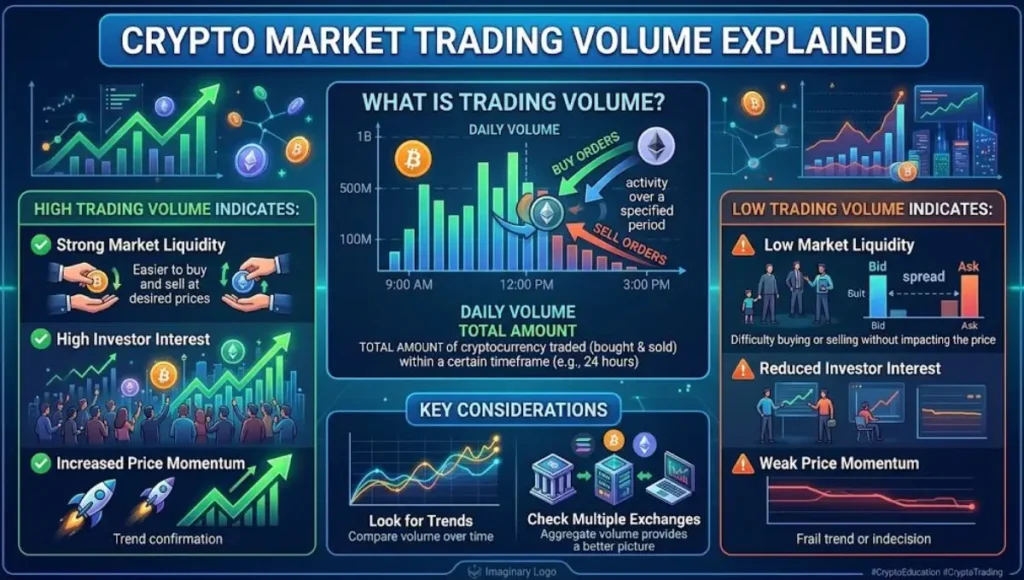
Trading volume measures the value of assets traded during a specific period.
For example, 24-hour volume shows how much trading activity occurred across the tracked market during the previous 24 hours.
High volume can indicate strong market activity, while low volume may indicate less trading activity. Volume should be considered alongside price, liquidity, market capitalization, and other information.
Crypto Market vs Stock Market
The crypto market and stock market both use buyers and sellers to establish prices, but they have important differences.
| Feature | Crypto Market | Stock Market |
| Trading hours | Often 24/7 | Usually set exchange hours |
| Assets | Digital assets | Shares of companies and other securities |
| Market structure | Global and fragmented | More centralized and regulated |
| Volatility | Can be very high | Varies by stock |
| Settlement | Blockchain or exchange systems | Traditional financial infrastructure |
| Ownership | Depends on the asset and custody method | Represents ownership or rights defined by the security |
The rules, investor protections, taxation, and regulatory treatment can also differ by country and asset type.
How to Analyze the Crypto Market
Market analysis can combine price data, market activity, blockchain information, and news.
Useful areas to examine include:
- Price trends
- Trading volume
- Market capitalization
- Bitcoin dominance
- Circulating and maximum supply
- Liquidity
- Network activity
- Project development
- Regulatory developments
- Broader economic conditions
Technical analysis studies price and volume patterns, while fundamental analysis looks at a project’s technology, use case, adoption, token economics, and development.
No single indicator can reliably predict what the market will do next.
Best Ways to Follow Crypto Market News
Reliable market information should come from established data providers, official project announcements, regulators, and reputable financial news sources.
When reading crypto news, check:
- The publication date
- The original source
- Whether the claim is confirmed
- Whether the information concerns a specific cryptocurrency or the whole market
- Whether the article separates facts from predictions
CoinGecko provides live market data and crypto news, while Binance provides market prices, trading volume, market capitalization, and market rankings.
Risks and Challenges in the Crypto Market
The crypto market can experience significant price movements and other risks.
The SEC’s Investor.gov warns that crypto-related investments can involve volatility, illiquidity, platform failure, regulatory changes, fraud, hacking, technical problems, and limited investor protections in some situations.
Important risks include:
- High price volatility
- Exchange or platform failure
- Cybersecurity attacks
- Scams and fraud
- Regulatory uncertainty
- Low liquidity in some assets
- Loss of private keys or access credentials
- Project or smart-contract failures
Because of these risks, market data should not be treated as a guarantee of future performance.
Is the Crypto Market Safe for Beginners?
The crypto market has significant risks, so beginners should learn how cryptocurrencies, exchanges, wallets, fees, and market orders work before making financial decisions.
It is also important to understand that past price performance does not guarantee future results. Official investor education resources recommend being aware of volatility, fraud, technical risks, and custody risks.
Future of the Crypto Market
The future of the crypto market will depend on technology, adoption, regulation, institutional participation, and broader economic conditions.
Areas receiving continued attention include:
- Stablecoins
- Decentralized finance
- Tokenized real-world assets
- Blockchain infrastructure
- Layer-2 networks
- Institutional crypto products
- Digital payments
The market is still developing, so future growth is possible, but individual projects can also fail or lose relevance.
Frequently Asked Questions
What is the crypto market?
The crypto market is the global marketplace for buying, selling, and exchanging cryptocurrencies and other blockchain-based digital assets.
What is the crypto market price today?
There is no single crypto market price. The overall market is measured using prices and market capitalization across thousands of cryptocurrencies.
Where can I check the crypto market live?
You can view live market data on established cryptocurrency data platforms and exchanges. Prices may vary slightly between platforms.
Where can I find a crypto market live chart?
Live charts are available on major cryptocurrency market-data websites and exchanges. They commonly show price, volume, market cap, and historical movements.
What is the best crypto market app?
There is no single app that is best for everyone. Compare data coverage, security features, fees, supported assets, and availability in your country.
How can I check the crypto market on Binance?
Binance provides a market overview showing cryptocurrency prices, 24-hour changes, trading volume, and market capitalization.
Where can I find the latest crypto market news?
You can follow established crypto data platforms, official project announcements, financial news sources, and regulatory websites for current information.
What is happening in the cryptocurrency market today?
As of the September 29, 2026 data checked for this article, the global market was around $2.91 trillion, with roughly $117 billion in 24-hour trading volume and Bitcoin dominance near 57.3%.
Conclusion
The crypto market is a large and constantly changing global market built around cryptocurrencies and blockchain-based assets.
Understanding market capitalization, trading volume, Bitcoin dominance, price trends, news, and risk can help readers understand what is happening in the market. Live figures should always be checked because crypto prices and market conditions can change within minutes.