

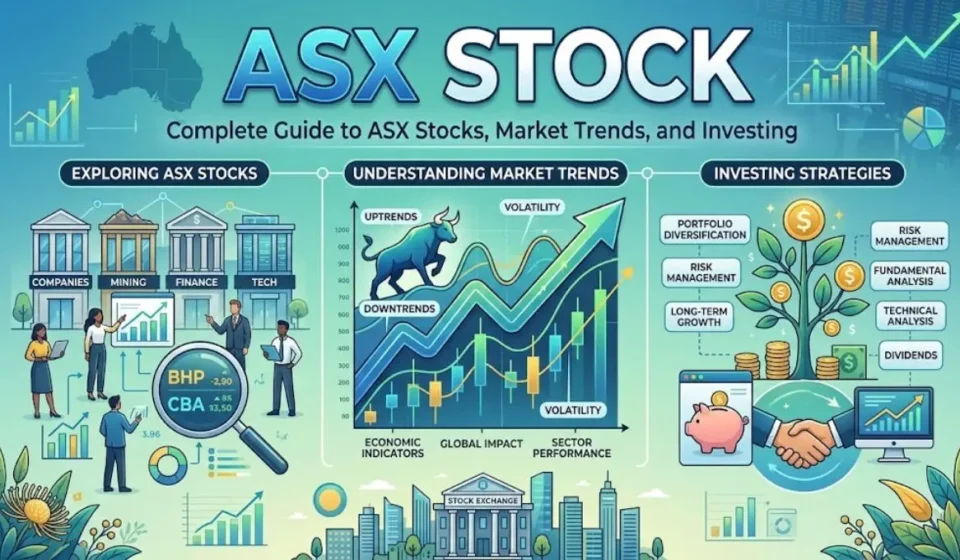

If you are searching for ASX stock information, it is important to understand that ASX is a stock exchange, not one individual company. The Australian Securities Exchange is the main marketplace where investors trade shares and other financial products in Australia.
This guide explains how ASX stocks work, what affects their prices, how investors research companies, and where to find current market information.
What Is an ASX Stock?
An ASX stock is a share of a company listed on the Australian Securities Exchange. Buying a share means owning a small part of that company.
ASX-listed companies range from large established businesses to smaller companies in areas such as mining, technology, healthcare, energy, finance, and consumer products.
The ASX provides access to more than 2,200 securities across its markets, according to ASX. Its company directory lets investors search by company name, ticker code, industry, and market capitalisation.
How Does the Australian Securities Exchange (ASX) Work?
The ASX is an electronic marketplace where buyers and sellers place orders through brokers and trading platforms.
During normal market activity, orders are matched according to price and time priority. The market also uses auctions at important points in the trading day.
For Australian cash equities, ASX settlement currently operates on a T+2 basis. This means a trade normally settles two business days after the trade date.
| Term | Simple meaning |
| ASX | Australian Securities Exchange |
| Ticker code | Short code used to identify a listed security |
| Share | A unit of ownership in a company |
| Market capitalisation | Share price multiplied by shares outstanding |
| Dividend | Money a company may distribute to shareholders |
| CHESS | Electronic system used for Australian share settlement |
Why Do Investors Buy ASX Stocks?
People buy shares for different reasons. Some look for long-term capital growth, while others focus on dividend income.
A share can potentially provide returns in two main ways:
- The share price increases.
- The company pays dividends.
However, neither outcome is guaranteed. Share prices can fall, and companies can reduce or stop dividends.
ASX also notes that investors may use shares as part of a diversified portfolio rather than relying on one company or sector.
How to Find the Best ASX Stock Opportunities
There is no single ASX stock that is automatically the right choice for every investor. The right research depends on goals, time horizon, risk, and the company itself.
A useful starting point is the ASX company directory. Investors can check a company’s ticker, industry, market capitalisation, listing information, and recent performance.
When researching a company, look at:
- Revenue and earnings
- Cash flow
- Debt levels
- Business model
- Industry conditions
- Management and strategy
- Dividend history
- Valuation
- Recent company announcements
It is also useful to compare a company with other businesses in the same industry instead of looking at its share price alone.
Key Factors to Consider Before Buying an ASX Stock
A low share price does not automatically mean a stock is cheap. Likewise, a high share price does not automatically mean it is expensive.
Consider the following factors before making an investment decision:
| Factor | Why it matters |
| Revenue | Shows the company’s sales activity |
| Profit | Helps show whether the business is earning money |
| Debt | High debt can increase financial pressure |
| Cash flow | Shows how cash moves through the business |
| Valuation | Helps compare price with business fundamentals |
| Dividend | May provide shareholder income |
| Growth | Shows possible expansion in the business |
| Competition | Can affect future market share |
A company’s financial statements, annual reports, investor presentations, and official ASX announcements can provide more useful information than social-media discussions.
ASX Stock Market Trends and Performance
The ASX market moves every trading day as investors respond to company news, economic data, interest rates, commodity prices, global markets, and changing expectations.
The S&P/ASX 200 is one of the most widely followed Australian market indexes. It is designed to represent 200 large, eligible ASX-listed companies and is widely used as a benchmark for Australian shares.
As a current 2026 reference, ASX reported that the S&P/ASX 200 closed at 8,665.00 on September 25, 2026, down 37 points, or 0.43%, for that session.
Market performance changes constantly, so readers looking for today’s figure should check the latest ASX market data rather than relying on an old article.
ASX Stock Sectors to Watch
ASX-listed companies cover many industries. The major sectors can behave differently because each responds to different economic conditions.
Common areas include:
- Financials
- Materials
- Energy
- Healthcare
- Information technology
- Industrials
- Consumer sectors
- Real estate
- Utilities
- Communication services
Materials and mining have an important place in the Australian market. ASX’s FY2026 listings review also highlighted the strong role of materials among international companies listing on the exchange.
Sector diversification can help reduce reliance on one part of the economy, although diversification does not remove investment risk.
How to Research an ASX Stock Before Investing
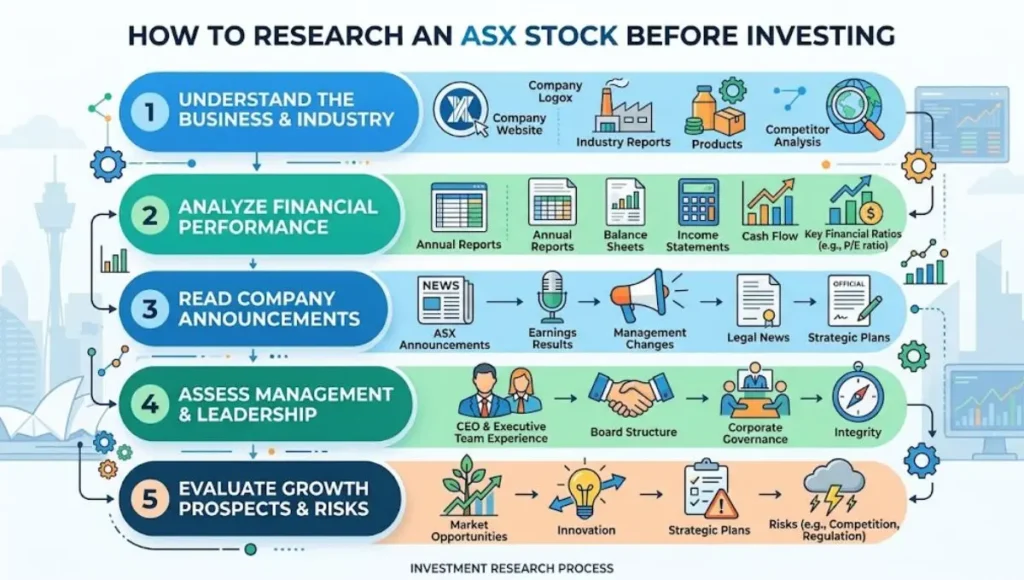
Good research starts with the company rather than the latest price movement.
First, understand what the business does and how it makes money. Then review its financial results and recent announcements.
A simple research checklist is:
- Read the latest annual report.
- Check recent financial results.
- Review revenue and profit trends.
- Look at debt and cash flow.
- Understand the company’s industry.
- Compare its valuation with similar companies.
- Check recent ASX announcements.
- Review dividend information if income matters to you.
- Consider the main risks.
- Avoid making a decision from one headline or one chart.
ASX provides education resources covering fundamental analysis, technical analysis, investment strategies, risks, dividends, and buying and selling shares.
ASX Stock Prices and What Influences Them
An ASX stock price is determined by buying and selling activity in the market. When demand for a share increases relative to available supply, its price can rise. When selling pressure increases, the price can fall.
Important influences include:
- Company earnings
- Profit expectations
- Interest rates
- Inflation
- Commodity prices
- Economic growth
- Exchange rates
- Government policy
- Industry developments
- Global market movements
- Company announcements
For mining companies, commodity prices and production expectations can be especially important. For banks and other financial companies, interest rates, credit conditions, and economic activity can have a major effect.
ASX Stock Dividends and Income Potential
Dividends are payments that companies may make to shareholders from profits or other available resources.
Many Australian companies pay dividends, although payment schedules and amounts vary. ASX explains that companies may pay interim and final dividends, while some may pay special dividends.
Important dividend dates include:
| Date | Meaning |
| Announcement date | Company announces the dividend |
| Ex-dividend date | Determines whether a new buyer qualifies for the upcoming dividend |
| Record date | Company checks eligible shareholders |
| Payment date | Dividend is paid |
Some Australian dividends can include franking credits. The tax treatment depends on the investor’s circumstances, so personal tax advice may be appropriate.
Risks of Investing in ASX Stocks
ASX stocks can provide growth or income, but they also involve risk. A company can perform poorly, lose market share, report weaker earnings, or face financial problems.
Share prices can also move sharply because of market conditions even when there has been no major change in the underlying business.
Key risks include:
- Market volatility
- Company-specific risk
- Economic risk
- Currency risk
- Sector risk
- Liquidity risk
- Dividend cuts
- Regulatory changes
Diversification can reduce the impact of one company performing poorly, but it cannot guarantee that an investment portfolio will avoid losses.
Asx Stock Price Prediction
An exact ASX stock price prediction cannot be known with certainty. Future prices depend on information and events that can change unexpectedly.
Analysts may use financial forecasts, valuation models, historical price data, technical indicators, and economic assumptions to estimate possible outcomes.
These estimates are scenarios, not guaranteed future prices. A prediction should therefore be treated as research rather than a promise of what an ASX stock will be worth.
For a current price, use live market data. For a future estimate, check the assumptions behind the forecast and compare multiple sources instead of relying on one number.
How to Buy an ASX Stock
To buy an ASX-listed share, an investor generally needs access to a broker or investment platform that supports ASX trading.
The basic process is:
- Choose a regulated broker that provides ASX access.
- Complete the required account and identity checks.
- Deposit funds if required.
- Search for the company’s ASX ticker code.
- Review the current market information.
- Select an order type.
- Submit the order.
- Check that the trade was executed.
- Monitor the investment and company announcements.
Brokerage, currency conversion, platform charges, and other fees can vary.
For anyone under the legal age to open an investment account, actual investing may require a parent, guardian, or other legally authorized adult, depending on the country and provider.
ASX Stock vs. Other Global Markets
ASX is Australia’s major securities exchange, while other countries have their own major exchanges.
| Market | Country/region | Example benchmark |
| ASX | Australia | S&P/ASX 200 |
| NYSE | United States | Various major indexes |
| Nasdaq | United States | Nasdaq Composite |
| LSE | United Kingdom | FTSE indexes |
| TSX | Canada | S&P/TSX Composite |
The companies, currencies, regulations, trading hours, tax rules, and market structures can differ between exchanges.
Some companies can have listings or securities connected with more than one exchange. For example, Nasdaq reported in September 2026 that Sigma Lithium began trading on ASX while continuing its Nasdaq and TSX Venture trading.
Frequently Asked Questions
What is the ASX stock price?
There is no single ASX stock price because ASX lists many different securities. Each company has its own ticker and current market price.
Is ASX stock listed on Nasdaq?
ASX itself is not a Nasdaq-listed stock. ASX is an Australian exchange, while Nasdaq is a separate U.S. exchange.
What is the ASX stock index?
The S&P/ASX 200 is a major Australian stock-market index that tracks 200 large, eligible ASX-listed companies.
Where can I find an ASX stock price chart?
You can use the ASX website, a broker, or a financial-data service that provides current ASX market information and historical charts.
What is an ASX stock company?
An ASX stock company is generally a company whose shares or other securities are quoted on the Australian Securities Exchange.
What is the ASX stock price in the US?
An ASX share normally trades in Australian dollars on ASX. A U.S. investor may also encounter a separate U.S. listing or security, where available, with its own price and currency.
What is the ASX stock price prediction?
There is no guaranteed future ASX stock price. Forecasts are estimates based on assumptions about company results, valuation, markets, and economic conditions.
What is the ASX stock price on NYSE?
An ASX-listed company does not automatically have a NYSE price. Only companies with a relevant NYSE listing or security can have a separate NYSE-traded price.
Final Thoughts
The term ASX stock covers thousands of investment opportunities across different companies and industries. Understanding the exchange, company fundamentals, market trends, dividends, valuation, and risks is more useful than focusing only on today’s share price.
For current prices and market movements, use up-to-date ASX data. Before making an investment decision, research the company carefully and consider your own circumstances, risk level, and investment goals.