

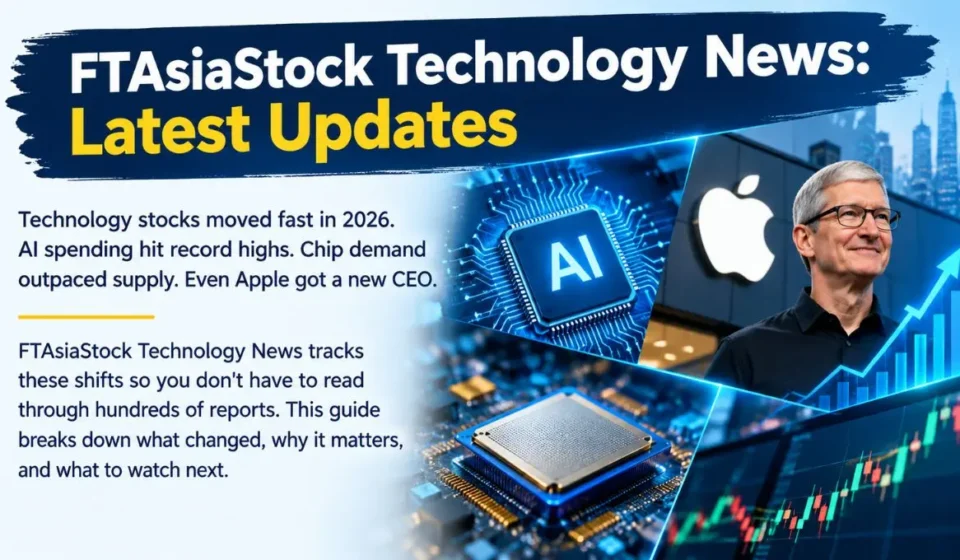

Technology stocks moved fast in 2026. AI spending hit record highs. Chip demand outpaced supply. Even Apple got a new CEO.
FTAsiaStock Technology News tracks these shifts so you don’t have to read through hundreds of reports. This guide breaks down what changed, why it matters, and what to watch next.
FTAsiaStock Technology News: Understanding the Changes Behind Market Movements
Direct answer: Tech stocks move when AI spending, chip supply, interest rates, or new trade rules change what investors expect. FTAsiaStock Technology News explains these shifts in plain language.
In 2026, a handful of forces are driving most market swings:
- AI infrastructure spending by big tech firms
- Chip supply and pricing cycles
- Central bank interest rate decisions
- Trade rules between the US and China
- Earnings surprises from major tech names
Each force connects to a section below. Once you understand them, tech headlines start to make a lot more sense.
The AI Revolution and the Companies Building the Future
AI spending is no longer a side project for tech firms. It is now their biggest cost and their biggest bet.
NVIDIA’s market value stood at about $5.27 trillion in September 2026. The company posted $215.9 billion in revenue for its 2026 fiscal year, driven almost entirely by AI chip demand.
OpenAI added fresh momentum in September 2026 with GPT-6 Astra, a model the company says marks the start of what it calls the “AGI era.” That claim is still debated, but the model’s efficiency gains renewed interest in AI-linked stocks.
Microsoft, Meta, Amazon, and Alphabet together plan to spend roughly $724 billion on AI infrastructure in 2026. Analysts expect that figure to climb toward $950 billion in 2027.
| Company | Recent AI Move | Why It Matters |
| NVIDIA | Backing new AI data centers across Australia | Spreads chip demand beyond the US market |
| Microsoft | Crossed a key Azure AI revenue milestone | Shows AI is now core revenue, not a side bet |
| OpenAI | Released GPT-6 Astra | Raises the bar on model cost and efficiency |
| Apple | New CEO John Ternus took over on Sept 1, 2026 | Signals a fresh push to catch up in AI |
Even Apple, long seen as an AI latecomer, is feeling the pressure. Tim Cook stepped down as CEO after 15 years, handing the role to John Ternus while staying on as executive chairman.
Semiconductor Industry: The Hidden Engine Behind Technology Growth
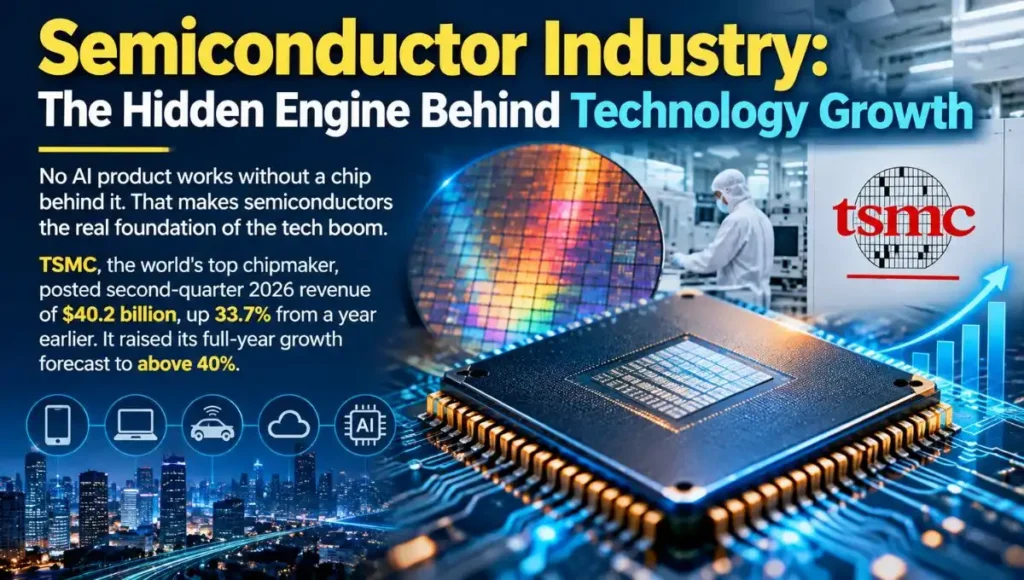
No AI product works without a chip behind it. That makes semiconductors the real foundation of the tech boom.
TSMC, the world’s top chipmaker, posted second-quarter 2026 revenue of $40.2 billion, up 33.7% from a year earlier. It raised its full-year growth forecast to above 40%.
TSMC now expects the global chip market to pass $1.5 trillion by 2030. AI and high-performance computing alone could drive more than half of that demand.
Memory chips are seeing an even sharper price jump:
- DRAM prices could rise 50-60% in a single quarter
- NAND flash prices may climb 75-100%
- Total memory chip revenue could grow 134% in 2026 alone
This price surge already pushed Micron’s market value past $1 trillion. For everyday buyers, it also means laptops and phones may get pricier through 2027.
Fintech Growth and the Changing Financial Landscape
Asia’s fintech market is growing faster than almost anywhere else in the world. Mobile-first habits and government-backed payment systems are the biggest reasons why.
The Asia-Pacific fintech market is valued at about $167.71 billion in 2026. It is expected to grow roughly 16% a year, reaching $348.1 billion by 2031.
China holds the largest share of the region’s fintech market, at around 40%. India is the fastest-growing, expanding close to 27% a year on the back of its UPI payment network.
| Country / Region | What’s Driving Growth |
| India | UPI payments and RBI-backed digital lending rules |
| Singapore & Thailand | PayNow and PromptPay real-time transfers |
| Philippines & Southeast Asia | Super apps like GCash and Grab combining payments and loans |
| Hong Kong & Singapore | New rules opening the door to stablecoins and tokenized assets |
Neobanks, or fully digital banks, are also growing fast. New licenses in Australia, Hong Kong, and Singapore are pushing this segment up nearly 30% a year.
Cloud Computing and the Digital Business Era
Every AI model needs somewhere to run. That somewhere is the cloud, and spending there is exploding.
Amazon Web Services still leads with close to 30% of global cloud infrastructure spending. Microsoft Azure holds roughly a quarter of the market, while Google Cloud sits around 13-15%.
Growth rates tell a different story than market share:
| Provider | Approx. Market Share (2026) | Recent Growth Rate |
| AWS | ~30% | 19-28% |
| Microsoft Azure | ~24-25% | ~40% |
| Google Cloud | ~13-15% | 63-82% |
Enterprise cloud spending hit $143 billion in the second quarter of 2026 alone. AI workloads now make up close to a fifth of all cloud spending, up from just 8% in 2023.
The global cloud computing market is on track to top $1 trillion in 2026. Asia-Pacific is the fastest-growing region, helped by India’s data center build-out and 5G rollout.
Cybersecurity: Protecting Asia’s Fast-Growing Digital Economy

More digital payments and cloud systems mean more targets for hackers. Asia’s cybersecurity spending is rising to match that risk.
The Asia-Pacific cybersecurity market is worth close to $84 billion in 2026. It is projected to grow about 13-14% a year, passing $158 billion by 2031.
A few numbers show how uneven the risk is across the region:
- Japan’s cybersecurity market is worth over $10 billion
- India’s market sits near $6 billion
- Taiwan reportedly faces close to 5 million cyberattacks every single day
AI is changing both sides of this fight. Early 2026 threat reports from CrowdStrike and Palo Alto Networks both flagged a sharp rise in AI-powered attacks, pushing companies toward AI-based defense tools too.
China alone plans to spend around $191 billion replacing foreign hardware and software in critical systems, a move tied to both security concerns and wider geopolitics.
Electric Vehicles and the Race for Clean Energy Technology
The EV race is no longer just about cars. It is about batteries, chips, and who controls the supply chain.
Global electric car sales are expected to reach about 23 million units in 2026, close to 28% of all new cars sold, according to the International Energy Agency.
China still leads by far. EVs made up nearly 60% of car sales there in the second quarter of 2026, even as total car sales fell over 20% due to a weaker economy.
Chinese automakers are responding by selling more overseas:
- Total vehicle exports from China jumped 65% in the first half of 2026
- Electric car exports alone grew more than 120% in the same period
Other parts of Asia are growing even faster in percentage terms. India’s EV sales rose about 86% in early 2026, while South Korea’s more than doubled.
Big Tech Earnings: Reading the Signals Behind Market Swings
Earnings season in 2026 has been anything but boring. The same AI spending boosting some stocks is dragging down others.
| Company | Q2 2026 Result | Stock Reaction |
| Amazon | Revenue up 19.6% to $200.6 billion; AWS grew 37% | Rose 8-10% |
| Microsoft | Crossed a major Azure revenue milestone | Jumped as much as 15% |
| Meta | Profit fell 14% on one-time charges; free cash flow dropped 91% | Fell as much as 11% |
| Apple | Record revenue of $109.4 billion, up 16% | Fell 3-4% on China and Services misses |
The pattern is clear. Investors are rewarding companies that can show AI spending is paying off, and punishing those where the payoff still looks unclear.
Combined, the four biggest tech spenders could report close to $950 billion in capital spending in 2027. That number alone is worth tracking through next year.
Regulatory and Geopolitical Shifts Reshaping Asia’s Tech Sector
Politics is now a bigger factor in tech investing than it used to be. Chip rules between the US and China shifted more than once in 2026.
In January 2026, the US allowed exports of advanced NVIDIA and AMD chips to China again, reversing part of an earlier ban. At the same time, TSMC, Samsung, and SK Hynix now need fresh yearly licenses just to keep running their China-based factories.
Enforcement still has teeth. Applied Materials was fined $252 million in February 2026 for illegally shipping restricted equipment to China.
China has pushed back too:
- New rare earth and magnet export controls, among the strictest ever announced
- Export limits on materials sent to Japan’s military, following tension over Taiwan
- Heavy state investment in replacing foreign tech across government systems
Japan alone supplies most of the world’s advanced photoresist chemicals, so any disruption there could ripple across the entire chip supply chain.
How Investors Should Read Technology Developments
Not every AI headline should change your portfolio. Some signals matter more than others.
Asian tech stocks beat global markets by about 5 percentage points in 2025, their best relative year since 2017. But some analysts now warn that AI-linked valuations are running ahead of actual profits.
A few numbers worth watching:
- Hong Kong-listed Chinese tech stocks trade around 19 times forward earnings
- The Nasdaq 100 trades closer to 25 times forward earnings
- Asia’s stock listing pipeline stayed strong, with about $267 billion raised across the region in 2025
This gap suggests some investors see more room for growth in Chinese tech, while others simply see more risk. Either read can be reasonable, depending on your own goals and risk tolerance.
This section is for general information only. It is not personal financial advice, so it’s worth checking with a licensed advisor before making investment decisions.
The Future of Technology and Investment Decisions
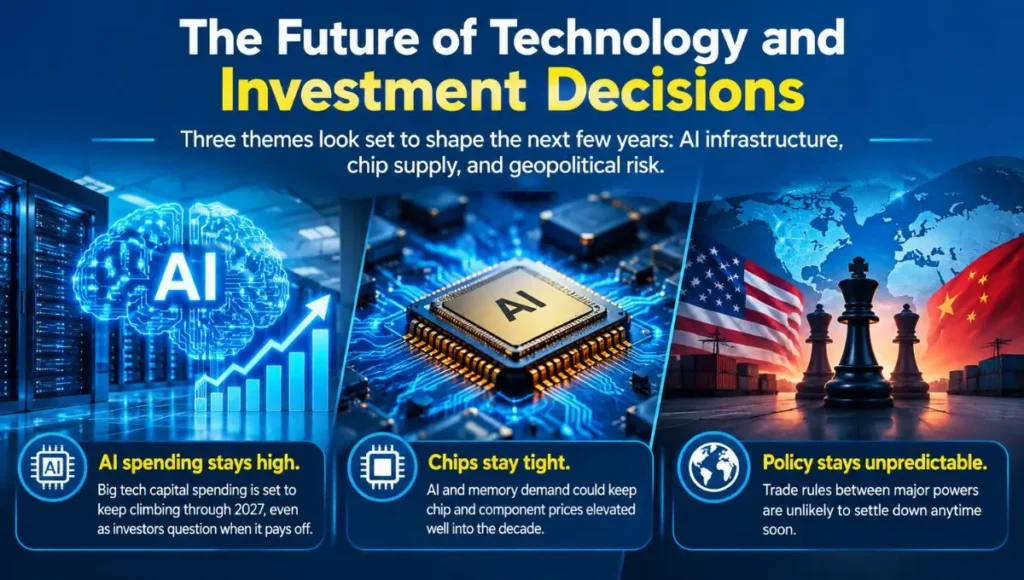
Three themes look set to shape the next few years: AI infrastructure, chip supply, and geopolitical risk.
- AI spending stays high. Big tech capital spending is set to keep climbing through 2027, even as investors question when it pays off.
- Chips stay tight. AI and memory demand could keep chip and component prices elevated well into the decade.
- Policy stays unpredictable. Trade rules between major powers are unlikely to settle down anytime soon.
Asia sits at the center of nearly all of this, from chip manufacturing to fintech adoption to EV exports. That makes staying updated through sources like FTAsiaStock Technology News more useful than ever.
Frequently Asked Questions
What is FTAsiaStock Technology News and what does it cover?
It covers how AI, chips, fintech, cloud, and EV trends move Asian and global tech stocks, explained in plain, everyday language.
Why are companies like NVIDIA and Microsoft central to the AI revolution?
NVIDIA supplies the chips that power AI, while Microsoft supplies the cloud and software most companies use to run it.
How do semiconductor trends affect the wider tech and stock market?
Chips power phones, cars, and data centers, so chip shortages or price swings ripple through nearly every tech stock.
What’s driving fintech growth across Asian markets?
Mobile payment systems like UPI and PromptPay, plus super apps like GCash, are pulling millions of new users into digital finance.
Why is cybersecurity becoming such a big investment theme in tech?
More digital payments, cloud systems, and AI tools create more targets, and AI is now making attacks faster too.
What technology trends should investors watch going forward?
Watch AI infrastructure spending, chip supply cycles, EV export growth, and shifting US-China trade rules.
Final Thoughts
Technology news moves fast, but the big themes stay fairly steady. AI spending, chip supply, fintech adoption, and geopolitics are behind almost every major move in 2026.
FTAsiaStock Technology News aims to make sense of these shifts without the jargon. Bookmark this page and check back as new updates roll in.